Liver health

Restore your liver health, early

Daily Liver Restore · a liver-specific probiotic for the earliest, most recoverable stage

Caught early, liver health can be restored. Most liver supplements have thin evidence — so we're building something better: a strain-specific, next-generation probiotic headed for clinical trial, designed to work with your gut–liver axis and restore the balance the disease disrupts. Built by scientists and doctors.

$49.50 / month estimated · no payment taken today
Thanks — you're on the list. We'll be in touch as we get closer. ✓

No payment taken · grounded in peer-reviewed research · clinical trial planned

Coming soon Daily Liver Restore — a daily probiotic for early-stage fatty liver

Could this be fatty liver? A 30-second self-check

Fatty liver is often silent — most people have no obvious symptoms. Answer a few questions about known risk factors. This is an educational risk indicator, not a diagnosis.

Are you overweight, or carry weight around the middle?
Do you have type 2 diabetes, prediabetes, or high blood sugar?
High cholesterol, triglycerides, or blood pressure?
Have you been told you have raised liver enzymes / high ALT?
Has a scan or doctor ever mentioned a "fatty" liver?
Ongoing tiredness or a dull ache under your right ribs?

We'll email a plain-English summary and let you know when our clinical trial and early-access program open. No spam.

Thanks — check your inbox. You're on the early list. ✓

Caught early, liver health is at its most recoverable

Around 4 in 10 adults have fatty liver — and most have no idea. Before scarring sets in (the early F0–F1 stage), the liver has a remarkable capacity to recover. That early window is exactly what our science targets.

~40%
of adults have fatty liver
~95%
don't know they have it
F0–F1
the early, recoverable stage we target

Have recent blood results? Check your fibrosis risk

If you have a recent blood test, enter four values for your FIB-4 score — the standard measure clinicians use to gauge liver-scarring risk. A risk estimate only, not a diagnosis.

The science, in plain terms

Fatty liver drives the liver into a state of oxidative stress — its natural antioxidant defenses get overwhelmed and low-grade inflammation takes hold. Our approach is a probiotic to work with your gut to help correct that imbalance — through the gut–liver axis.

🛡️

Restore antioxidant balance

Designed to support the body's own antioxidant defenses and shift the liver's redox balance back toward normal.

🔥

Calm low-grade inflammation

Targets the chronic, silent inflammation that accompanies early fatty liver.

🌱

Work through the gut–liver axis

A probiotic that acts locally in the gut to support the liver — delivered where it's needed.

A probiotic capsule opening to reveal its active formulation

Full formulation details are proprietary and will be disclosed through peer-reviewed publication and our clinical program.7,10,11

Why the gut

Your gut and your liver are in constant conversation

The gut and liver are directly linked — connected by the portal vein, they exchange signals, nutrients and immune messages every minute of the day. This is the gut–liver axis, and a growing body of research places it at the very centre of how fatty liver develops and progresses.10,11

The gut sets the tone. When the gut barrier and its microbiome fall out of balance, signals cross to the liver that drive inflammation and oxidative stress — key steps in fatty liver progression.9,10
It's a two-way street. Because the connection runs both ways, supporting the gut is one of the most promising routes to supporting the liver — a strategy now actively explored in the scientific literature.11
This is where we work. Rather than acting on the liver from a distance, our probiotic works right at the source — in the gut — to influence the liver through this natural axis.10,11,12
Macro view of the gut–liver axis — gut and liver tissue in constant exchange
The gut–liver axis — where our probiotic works.

Why the early stage matters most

At the early stage — before significant scarring — the liver has a striking ability to recover. As fibrosis advances, that window narrows.

Stage predicts outcomes

In long-term studies, fibrosis stage — not fat or inflammation — is most closely associated with survival in fatty liver disease.1,2

Fibrosis can regress

Research shows liver fibrosis is dynamic, and regression appears more achievable at earlier stages than once advanced scarring has set in.5,6

Cutting-edge science

Recent discoveries, applied

Built on the last decade's breakthroughs in the gut–liver axis and engineered next-generation probiotics — a frontier only now becoming therapeutically real.10,11,12

Peer-reviewed foundations

Every mechanism we target is grounded in published, peer-reviewed research on oxidative stress and liver disease progression.7,8,9

Clinical trial planned

We're preparing a clinical study to measure real effects on liver and antioxidant markers. We lead with evidence, not claims.

The evidence

Not another supplement. A probiotic we're putting through clinical study.

Most liver supplements ask you to trust them. We carry out trials to show they work.

Our founding team are PhD scientists and medical doctors working at the frontier of microbiome and gut–liver science — the same fields our approach is built on. We lead with evidence, measure honestly, and will publish what we find.

Salpie Nowinski
CEO · PhD
Salpie Nowinski

PhD Computational Biology, King's College London.

Max Mossner
CTO · PhD
Max Mossner

PhD Molecular Biology, Heidelberg University.

Gabriel Nowinski
CMO · MD
Gabriel Nowinski

Medical doctor; ran a Phase III trial.

Our team's published research appears in leading peer-reviewed journals, including Gut, Cancer Discovery and Nature Cancer.

Study 1 · Pharmacokinetics — planned

First, we prove the delivery.

Before claiming any effect, we measure whether the probiotic's active compound actually reaches the body — in both its free and its protected, vesicle-encapsulated form — where conventional oral antioxidants are broken down before they can work. This is the delivery question every supplement skips.

What we measure
Active compound in blood (free) Active compound (protected / encapsulated) Glutathione (GSH)
Study 2 · Effect Study — planned

Then, we prove the effect.

Once delivery is established, a second study measures what the probiotic actually does — first the mechanism signals that only an engineered living probiotic can drive, then the metabolic and liver markers that matter to you.

Mechanism signals — the probiotic doing its job
Native gut-signalling response Gut antioxidant balance
Metabolic & liver markers
Liver fat ALT (liver enzymes) Antioxidant / glutathione balance Visceral fat & waist Post-meal glucose Insulin resistance

Studies are planned and not yet complete. Nothing here is a claim of clinical benefit — it is our commitment to measuring one. Full formulation details remain proprietary pending peer-reviewed publication.7,10,11
Fatty liver: your questions, answered plainly

Straight answers to what people most often search — grounded in current evidence, not marketing. This is general education, not medical advice; always speak to your doctor about your own situation.

Can early fatty liver be improved?
In its early stage — before significant scarring sets in — the liver has a striking ability to recover, and liver health can often be restored. Research shows the liver can shed substantial stored fat through sustained weight loss, dietary change and more activity. Once fibrosis (scarring) advances, recovery becomes much harder, which is why catching it early matters most. Work with your doctor on a plan suited to you.
Do liver detox products work?
There's no strong evidence that "liver detox" teas, cleanses or supplements clear fat from the liver or repair it — and a healthy liver already detoxifies your body on its own. The changes with real evidence behind them are gradual weight loss, cutting excess sugar and alcohol, and regular exercise. Be cautious of anything promising a quick detox or cure.
What are the symptoms of fatty liver?
Early fatty liver is usually silent — most people have no symptoms at all. When symptoms do appear, they can include ongoing tiredness and a dull ache or discomfort under the right ribs. Because it's so often symptom-free, it's frequently found by chance on a blood test (raised liver enzymes/ALT) or an ultrasound. Our free self-check flags common risk factors so you know whether to get tested.
How do I know if I have fatty liver?
It's usually identified through blood tests (liver enzymes such as ALT), an ultrasound or FibroScan, or a risk score like FIB-4 that combines your blood results and age. Our self-check and FIB-4 calculator give an educational risk estimate — not a diagnosis — to help you decide whether to ask your doctor for testing.
What is the best treatment for fatty liver?
For early fatty liver, lifestyle is the foundation and has the strongest evidence: gradual weight loss, less sugar and alcohol, and regular exercise. For more advanced disease, some prescription medicines now exist and are managed by a specialist. We're developing a next-generation probiotic for the early stage — it's currently in research and development and not yet available for sale.

References

  1. Angulo P, et al. Liver fibrosis, but no other histologic features, is associated with long-term outcomes of patients with NAFLD. Gastroenterology 2015;149:389–397.
  2. Dulai PS, et al. Increased risk of mortality by fibrosis stage in NAFLD: systematic review and meta-analysis. Hepatology 2017;65:1557–1565.
  3. Vilar-Gomez E, et al. Weight loss through lifestyle modification significantly reduces features of nonalcoholic steatohepatitis. Gastroenterology 2015;149:367–378.
  4. Romero-Gómez M, et al. Treatment of NAFLD with diet, physical activity and exercise. J Hepatol 2017;67:829–846.
  5. Trautwein C, et al. Hepatic fibrosis: concept to treatment. J Hepatol 2015;62(1 Suppl):S15–S24.
  6. Friedman SL, et al. Hepatic fibrosis 2022: unmet needs and a blueprint for the future. Hepatology 2022;75:473–488.
  7. Chen Z, et al. Role of oxidative stress in the pathogenesis of nonalcoholic fatty liver disease. Free Radic Biol Med 2020;152:116–141.
  8. Buzzetti E, Pinzani M, Tsochatzis EA. The multiple-hit pathogenesis of NAFLD. Metabolism 2016;65:1038–1048.
  9. Tilg H, Moschen AR. Evolution of inflammation in NAFLD: the multiple parallel hits hypothesis. Hepatology 2010;52:1836–1846.
  10. Albillos A, de Gottardi A, Rescigno M. The gut–liver axis in liver disease: pathophysiological basis for therapy. J Hepatol 2020;72:558–577.
  11. Aron-Wisnewsky J, et al. Nonalcoholic fatty liver disease: modulating gut microbiota to improve severity? Gastroenterology 2020;158:1881–1898.
  12. Barra M, et al. Engineered probiotics for detection and treatment of inflammatory intestinal diseases. Front Bioeng Biotechnol 2020;8:265.
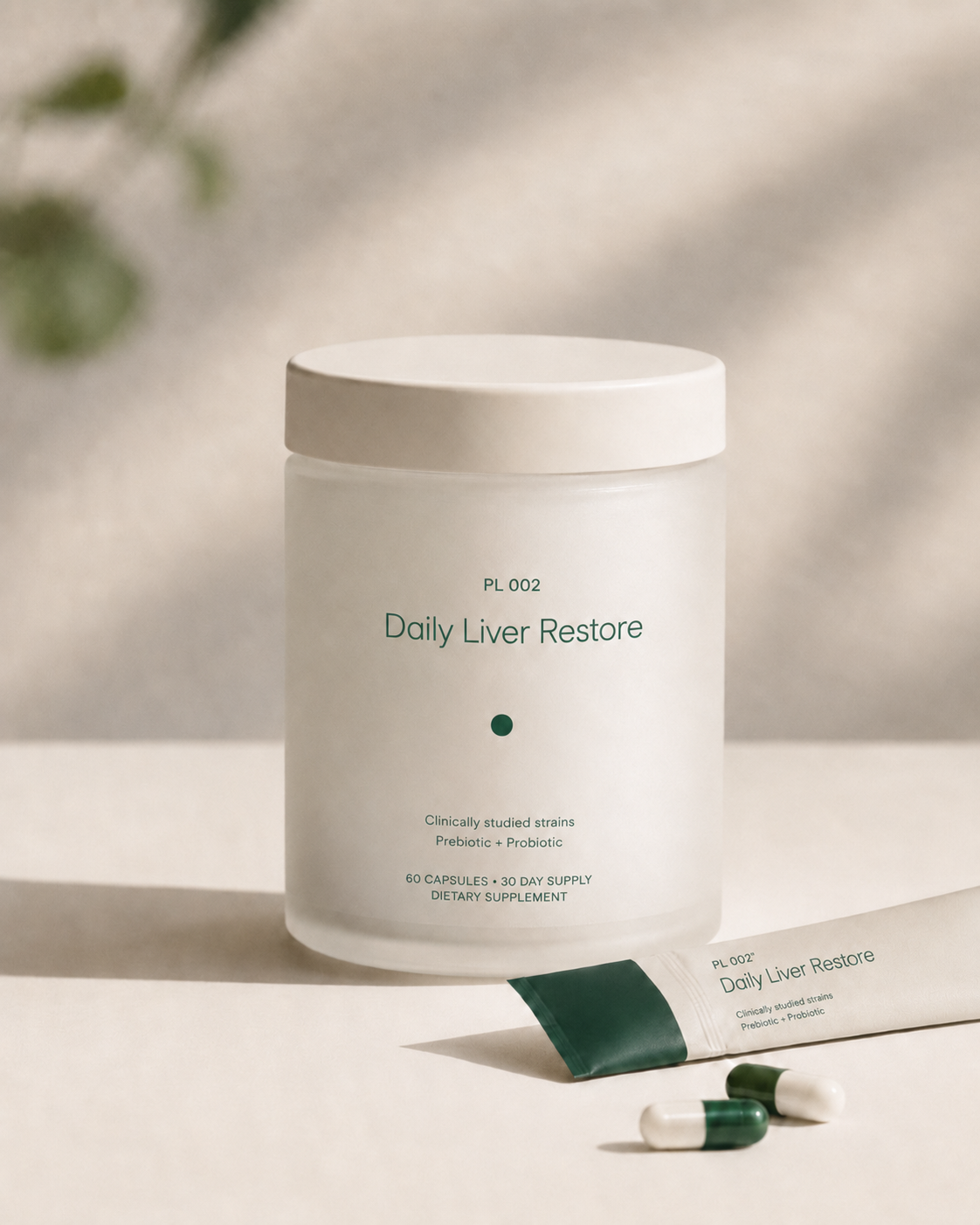
Daily Liver Restore

Clinically-studied strains · a daily probiotic for the early, recoverable stage

$49.50/month (est.)

Indicative early-access pricing · no payment taken today

  • Daily probiotic for early-stage fatty liver
  • A medical food, taken under the guidance of your own physician
  • Formulated around specific, clinically-studied strains
  • Priority place in our trial & early-access program

Reserve your place — we'll be in touch as the trial and launch approach

We'll email you about the trial and early access. No spam.

You're on the list ✓

We'll be in touch as our clinical trial and early-access program open. Thank you.

✓ Peer-reviewed science ✓ Clinical trial planned ✓ Cutting-edge probiotic technology
Our mission

Pioneering next-generation probiotics for human and planetary health