Perimenopause & menopause

Bloated, heavier, and told
it's just menopause?

A daily probiotic for gut comfort through the change — where your metabolism begins.

As estrogen falls, the gut microbiome shifts — driving the bloating, the "meno belly" and the weight that won't budge. So many women feel pushed toward a GLP-1 they don't really want. We're building a next-generation probiotic, headed for clinical trial, that supports your gut through the transition — the foundation your metabolism and your body's own appetite hormones are built on. Not a drug. Not a "natural Ozempic." The gut layer that comes first.

$54 / month estimated · no payment taken today
Thanks — you're on the list. We'll be in touch as we get closer. ✓

No payment taken · grounded in peer-reviewed research · clinical trial planned · a dietary supplement, not a medication

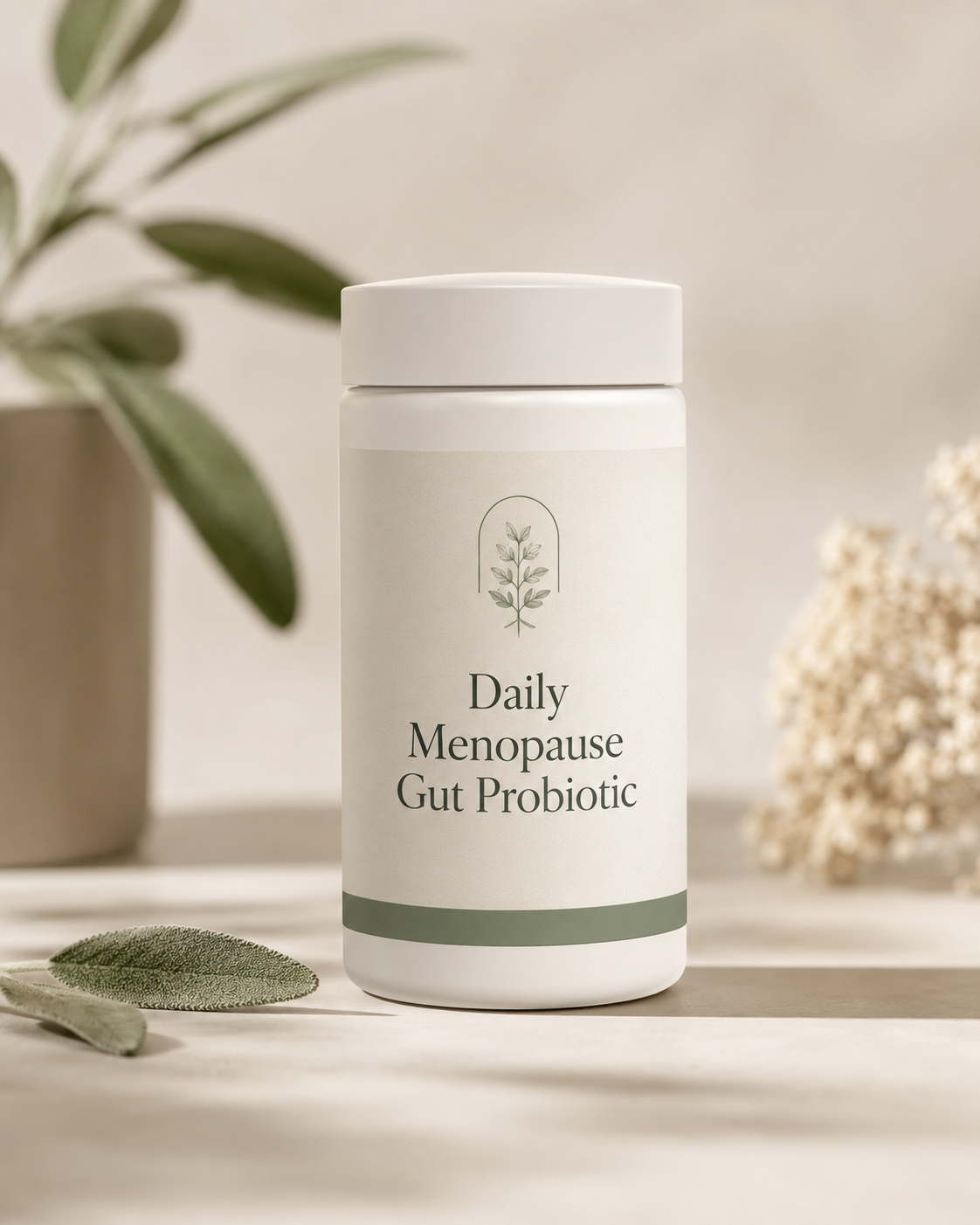
Coming soon Daily Menopause Gut Probiotic — a daily probiotic to support gut comfort through the menopause transition

Is your gut part of your menopause story? A 30-second check

A few quick questions about what you're noticing. This is educational only — always talk to your doctor about your symptoms and treatment.

Are you in perimenopause or menopause (or noticing the changes starting)?
New or worse bloating, gas or "meno belly"?
Weight around the middle that diet doesn't shift like it used to?
Feeling pushed toward a GLP-1 (Ozempic/Wegovy) you'd rather avoid?
Digestion just feels different since your cycle changed?
Want to support your gut and metabolism through the change, the foundational way?

We'll email a plain-English summary and let you know when our clinical trial and early-access program open. No spam.

Thanks — check your inbox. You're on the early list. ✓

It's not in your head — and it's not just "getting older."

Bloating and belly changes are among the most common symptoms of the menopause transition, and among the least talked about. As estrogen falls, your gut microbiome changes with it — affecting digestion, comfort and metabolism. Almost no one is building for this. We are.

1.1B
women worldwide in menopause by 2025
Top 5
bloating ranks among the most-reported transition symptoms
Estrogen–gut
the connection most women are never told about

Why the gut — and why now

Your gut and your hormones are in constant conversation. A family of gut bacteria — the estrobolome — helps regulate the estrogen circulating in your body. As estrogen falls through the transition, that balance shifts, and digestion, comfort and metabolism shift with it. That's where we work.

🌸

The estrobolome connection

Gut bacteria help recycle and regulate estrogen. As their balance changes in menopause, symptoms can follow — so the gut is a place worth supporting.

🌱

Gut comfort through the change

Designed to support the gut barrier and microbiome as estrogen falls — the bloating, gas and "meno belly" so many women describe.

⚙️

The foundation of metabolism

A healthy microbiome produces the short-chain fatty acids that signal the gut hormones behind appetite and blood sugar — including the ones a GLP-1 amplifies. Support the source.

A probiotic capsule opening to reveal its active formulation

Full formulation details are proprietary and will be disclosed through peer-reviewed publication and our clinical program. This is a dietary supplement in development, not a medication and not a substitute for treatments like HRT.1,2,5

Not sure about a GLP-1?

Start with your gut — where your metabolism and your own appetite hormones begin.

GLP-1 medications work by amplifying a hormone your gut already makes. Whether or not a drug is right for you, the gut is the common ground — and the place to start.

If you'd rather not go on a GLP-1

Before adding a medication, it's worth supporting the system that makes your own appetite and metabolic hormones. A healthier gut microbiome is the foundation that signalling is built on — and it's the felt problem (bloating, comfort, the belly) you can act on today. That's where we work.

If you're on one — or considering it

The same gut support is designed to help through the digestive side effects — nausea, constipation, bloating — that come with GLP-1 treatment. It's a companion to your medication, never a replacement. Always talk to your doctor.

We don't make "natural Ozempic" or weight-loss claims. A probiotic is not a GLP-1 medication. What it does will be measured in our planned clinical study, not assumed.3,4

The estrogen–gut axis

Your hormones and your gut are one conversation.

The link between estrogen and the gut microbiome runs both ways — which is why the transition shows up so often in your digestion, and why the gut is a place you can actually support.1,2

Estrogen shapes the microbiome — and the microbiome shapes estrogen. The estrobolome helps regulate circulating estrogen; as estrogen falls, microbiome diversity often changes too.1,2,5
That's why the belly and bloating arrive together. Shifts in the gut, motility and metabolism during the transition drive the symptoms women describe most — and are the least served by existing products.5
This is where we work. Rather than acting on the body from a distance, our probiotic is designed to work right at the source — in the gut — through the change.3,4
Macro view of gut tissue — the site of the estrogen–gut axis
The estrogen–gut axis — where the transition is felt, and where we work.

Cutting-edge science

Recent discoveries, applied

Built on the last decade's breakthroughs in the estrogen–gut axis and engineered next-generation probiotics — a frontier only now becoming therapeutically real.1,2,4

Peer-reviewed foundations

Every mechanism we target is grounded in published, peer-reviewed research on the microbiome, the estrobolome and metabolic health.1,2,3,5

Clinical trial planned

We're preparing a clinical study to measure real effects on gut comfort, the microbiome and metabolic markers. We lead with evidence, not claims.

The evidence

Not another menopause supplement. A probiotic we're putting through clinical study.

Most menopause products ask you to trust them. We carry out trials to show they work.

Our founding team are PhD scientists and medical doctors working at the frontier of microbiome and gut science — the same fields our approach is built on. We lead with evidence, measure honestly, and will publish what we find.

Salpie Nowinski
CEO · PhD
Salpie Nowinski

PhD Computational Biology, King's College London.

Max Mossner
CTO · PhD
Max Mossner

PhD Molecular Biology, Heidelberg University.

Gabriel Nowinski
CMO · MD
Gabriel Nowinski

Medical doctor; ran a Phase III trial.

Our team's published research appears in leading peer-reviewed journals, including Gut, Cancer Discovery and Nature Cancer.

Study 1 · Delivery — planned

First, we prove the delivery.

Before claiming any effect, we measure whether the probiotic survives, colonises and produces its active compounds in the gut — the step most supplements never test. No delivery, no effect.

What we measure
Strain survival & colonisation Short-chain fatty acid output Active compound in the gut
Study 2 · Effect Study — planned

Then, we prove the effect.

Once delivery is established, a second study measures what the probiotic actually does — first the gut mechanism, then the comfort and metabolic markers that matter to women through the transition.

Mechanism signals — the probiotic doing its job
Microbiome diversity Estrobolome markers
Comfort & metabolic markers
Bloating / GI comfort scores Waist circumference Post-meal glucose Satiety / appetite signalling Lean mass retention

Studies are planned and not yet complete. Nothing here is a claim of clinical benefit — it is our commitment to measuring one. Full formulation details remain proprietary pending peer-reviewed publication.1,3,5

Menopause & your gut: your questions, answered plainly

Straight answers to what women most often search about bloating, belly and gut changes through the transition — grounded in current evidence, not marketing. This is general education, not medical advice; always speak to your doctor about your own symptoms and treatment.

Why am I so bloated in perimenopause?
As estrogen levels fall and fluctuate, the gut microbiome shifts and gut motility changes — which for many women means new or worse bloating, gas and a "meno belly." It's one of the most common and least-discussed symptoms of the transition. Supporting the gut microbiome and barrier is an area of active research. Speak to your doctor about persistent symptoms.
Does menopause affect gut health?
Yes. Estrogen and the gut microbiome are closely linked through the "estrobolome" — the gut bacteria that help regulate circulating estrogen. As estrogen declines, microbiome diversity often changes, which can affect digestion, bloating and metabolic health. We're developing a next-generation probiotic designed to support the gut through this transition; it's in research and development and not yet available.
Can a probiotic help with menopause weight or belly fat?
Weight gain around the middle in menopause is driven by falling estrogen, changing metabolism and muscle loss. A healthy gut microbiome is part of that metabolic picture — the short-chain fatty acids gut bacteria produce help signal the gut hormones involved in appetite and blood sugar. We don't make weight-loss claims; our probiotic is designed to support gut and metabolic health, and its effects will be measured in a planned clinical study rather than assumed.
Is this a natural alternative to Ozempic or a GLP-1?
No. We don't make "natural Ozempic" claims. GLP-1 is a hormone your gut naturally produces, and a healthy microbiome supports the gut where that signalling begins — but a probiotic is not a GLP-1 medication and is not a substitute for one. If you're considering or taking a GLP-1, our probiotic is designed to support your gut alongside it. Discuss any medication with your doctor.
Can I take this with HRT?
Our probiotic is being developed as a dietary supplement to support gut comfort through the transition, and is intended to sit alongside — not replace — treatments like HRT that you and your doctor decide on. Always tell your prescriber about any supplement you take. This is general education, not medical advice.
References

  1. Baker JM, Al-Nakkash L, Herbst-Kralovetz MM. Estrogen–gut microbiome axis: physiological and clinical implications. Maturitas 2017;103:45–53.
  2. Kwa M, Plottel CS, Blaser MJ, Adams S. The intestinal microbiome and estrogen receptor–positive female breast cancer. J Natl Cancer Inst 2016;108:djw029.
  3. Tolhurst G, et al. Short-chain fatty acids stimulate glucagon-like peptide-1 secretion via the G-protein–coupled receptor FFAR2. Diabetes 2012;61:364–371.
  4. Everard A, et al. Cross-talk between Akkermansia muciniphila and the intestinal epithelium controls diet-induced obesity. Proc Natl Acad Sci USA 2013;110:9066–9071.
  5. Peters BA, et al. Menopause is associated with an altered gut microbiome and estrobolome, with implications for adverse cardiometabolic risk. mSystems 2022;7:e00273-22.
  6. Santoro N, Roeca C, Peters BA, Neal-Perry G. The menopause transition: signs, symptoms, and management options. J Clin Endocrinol Metab 2021;106:1–15.
Daily Menopause Gut Probiotic

Clinically-studied strains · a daily probiotic to support gut comfort & metabolism through the change

$54/month (est.)

Indicative early-access pricing · no payment taken today

  • Daily probiotic for gut comfort through perimenopause & menopause
  • Designed to support the estrogen–gut axis and the belly & bloating
  • A dietary supplement — not a drug, not a "natural Ozempic"
  • Priority place in our trial & early-access program

Reserve your place — we'll be in touch as the trial and launch approach

We'll email you about the trial and early access. No spam.

You're on the list ✓

We'll be in touch as our clinical trial and early-access program open. Thank you.

✓ Peer-reviewed science ✓ Clinical trial planned ✓ A supplement that works with your body, not against it
Our mission

Pioneering next-generation probiotics for human and planetary health